How To Help Your Child Cope With Jealousy!
The thing about jealousy is that we all get jealous at some point in our lives. However, when the jealousy turns into bitterness and the person acts on it by causing deliberate harm of any sort or by taking the joy out of someone else’s misery then that is not very kind, isn’t it?
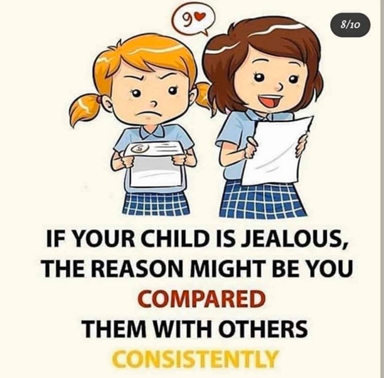
Sometimes parents unintentionally provoke or instil jealousy by comparing their child with others. Dear parents, please stop comparing children to others because the message you are giving is “You are not good enough.” I know we all want to know how well our children are performing socially, emotionally, physically and academically and naturally, parents compare. However, just don’t share your thoughts out loud in front of your child. Who wants to be compared to someone else? If you are explicit about your feelings of comparison and you keep comparing your child with a sibling or a friend, it may generate the feeling of rivalry, low confidence, and jealousy.
Jealousy is common in children. Children may often quarrel and have conflicts due to jealousy. A jealous child could fear that they are losing love and attention from their parents or caregivers. This may result in anxiety and anger towards siblings or friends who are getting attention.
Children have to learn how to deal with jealousy, they are new to the emotion and may not know what to do. If left unchecked, jealousy can lead to direct consequences, such as:
Lowered self-esteem
Aggression toward other kids
A feeling of helplessness
Bullying
Isolation
To help your child deal with envy, talk with him or her about the most common sources of jealousy.
Material jealousy
Academic or skills jealousy
Social jealousy
Sibling jealousy
Turn feelings of jealousy into productivity
Directing your child’s envy to a positive channel is a great way to reduce their negative feelings. For instance, if your child is sad because their friend received good grades, or if they lost at a football match, you may encourage and motivate them to study harder or practice harder and focus their achievement on effort rather than their ability to get better results. Therefore, channel their focus in the right direction.
Get to the root cause of jealousy
Talk to your child and know the reason why they are jealous of a particular person and then listen without judgment. There may be cases where your child may have lower self-esteem and confidence. Handle it with care; acknowledge what they are feeling and work on building their confidence. Get expert advice if you need tips on how to empower your child.
Allow your child to talk about their insecurities; talking about their jealous moments may open dialogue and an opportunity for growth. Ask your child how can he/she deal with it in a healthy way?”
Don’t compare your child to others
Never compare one child’s schoolwork, report cards, and test scores with their siblings or friends. They will not help your child to work harder. Instead, they fuel up resentment in them. Instead, teach children to stop comparing their weaknesses to another’s strengths.
Focus on your child's strengths
Every child has strengths. Talking about that particular strength will nurture their self-esteem. You can also focus your attention on your child’s effort, rather than comparing his or her performance to that of others. Everyone can practice and work hard to improve. Teach your child that being the best isn’t the point, it’s being the best you can be is what is important. Highlight Strengths; build your child’s self-worth and connect them with their strengths.
We need to tell our kids that we treat people the way we want to be treated. Remind your child that everyone is unique and each person should be the best version of himself or herself. Get into the habit of appreciating others’ strengths. Teach your child to manage their behaviour rather than their Feelings, giving themselves control over their feelings means that they can conduct themselves with dignity; instead of giving in to irrational emotion. Draw a hard line around behaviour
Help your child improve
Another method for dealing with feelings of jealousy is to help your child improve in the areas in which he or she feels inadequate. Perhaps if jealousy is arising because of class math then private math tutoring or making sure homework is completed might be exactly what your child needs to catch up and feel more confident. Give the message to your child that "being different is okay and if you want to get better at something just you keep trying and don’t give up, you’ll get better but if you stop, you’ll get nothing.”
Practice gratitude
Practising gratitude with your child, an appreciation for material possessions, unique characteristics, and personal skills can diminish many of the feelings of jealousy that children have. There are many ways to teach your child to be grateful but check your own habits to make sure you’re modelling a positive example. By showing gratitude for your own talents, family, and life, you teach your kids that it’s not about what you have, but what you do with it. Instead, practice what you preach, model gratitude and a sense of self-worth by verbalising your appreciation for the items and talents you do have. Nothing teaches your child better than the example you set.
Focusing on experiences
Jealousy may be a result of focusing too much on material goods and social media does not help either. By opting for cool experiences, for instance, spending time with your kids, a trip to the park, museum, or a family vacation instead of a new smartphone, your child learns that there are more important things than “stuff.”
Overindulging
Giving in and buying your child everything he or she wants won’t stop jealousy. Instead, children can become consumed by the pursuit of accumulating things. By learning to say no, you can instil a sense of appreciation for the times when you say yes, which naturally teaches your child to value the things he or she receives.
Jealousy is a common childhood emotion, especially in children with siblings. Single children can also be jealous of their friends or cousins. You may divert your child’s attention towards positive feelings. You may also seek expert help if things have grown out of your hand. Ignoring and neglecting jealousy could negatively impact mental wellbeing in the future.
Meet the Trainer
Hello, my name is Arlette and I am a mother of two daughters. I am the Founding Director of Parent Tree; I am also a trained psychologist, parent coach, certified trainer, and school well-being consultant with over 20 years of counselling experience.
I believe that an awareness of the self is the key to a more joyful and fulfilling parenting experience. That’s why I created my course From Crazy To Calm - The Empowered Parent Program. Self-Awareness For More Joyful Parenting to help parents gain more self-awareness. When you enrol in my course, you become part of a private support group where parents interact and share meaningful feedback with each other https://arletteshohmelian.podia.com/crazy-to-calm-the-empowering-parent-program
I would love to hear from you!
Book an online session: https://arletteshohmelian.podia.com/book-session
Subscribe to my newsletter: https://arletteshohmelian.podia.com/blog
Website: https://arletteshohmelian.podia.com
Facebook: https://www.facebook.com/ParentTreeArletteShohmelian
Linkedin: https://www.linkedin.com/in/arlette-shohmelian-parentcoach-trainer/
Instagram: https://www.instagram.com/parenttree_arlette_shohmelian